Can Dietary Nitrates Help You Maintain Sprint Performance?
TLDR
A new randomized crossover study found that an acute dose of dietary nitrate taken before exercise helped recreational athletes maintain peak power, mean power, and total work across four repeated 30 second cycling sprints. The benefit was similar in men and women.
Interestingly, nitrate supplementation did not appear to improve resting muscle microvascular function, muscle oxygenation during exercise, or corticospinal excitability. That suggests the performance benefit may come from other mechanisms, potentially including improved muscle contractile function, calcium handling, or energy production.
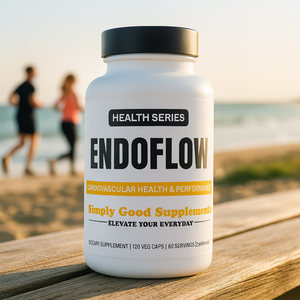
For athletes looking for a practical nitrate source, Simply Good EndoFlow provides 350 mg of nitrate per serving from NO3 T® betaine nitrate and is designed to be taken about two to three hours before exercise.
Can Dietary Nitrates Help You Maintain Sprint Performance?
Dietary nitrates have become one of the more interesting performance supplements in endurance sports.
Runners and cyclists have used beetroot juice for years because nitrate can increase nitric oxide availability and may improve exercise efficiency.
But nitrates might not be just for endurance athletes.
What if they could also help during repeated high intensity efforts?
Think about a soccer player making sprint after sprint late in a match.
A basketball player repeatedly accelerating down the court.
A CrossFit athlete trying to maintain power through multiple hard intervals.
Or a runner pushing through the final repetitions of a demanding track workout.
In these situations, producing one great effort is only part of the challenge.
The real challenge is maintaining your power as fatigue builds.
A new 2026 study published in Biology of Sport investigated whether dietary nitrate supplementation could help athletes do exactly that.
The results suggest nitrates may help athletes resist the normal performance decline that occurs during repeated maximal efforts.
What Are Dietary Nitrates?
Nitrate is a naturally occurring compound found in foods such as:
- Beets
- Spinach
- Arugula
- Celery
- Lettuce
- Other leafy green vegetables
Once consumed, nitrate is converted into nitrite and eventually nitric oxide.
Nitric oxide is an important signaling molecule involved in several physiological processes related to exercise performance.
It can influence:
- Blood vessel dilation
- Blood flow
- Mitochondrial efficiency
- Muscle contraction
- Calcium handling
- Oxygen utilization
The study authors note that nitric oxide may help mitochondria generate more ATP for a given amount of oxygen and may influence maximal muscle contractility through effects on calcium release and muscle cell excitability.
Those effects have made dietary nitrate one of the most studied nutritional strategies for endurance performance.
The evidence for sprinting, however, has been much less clear.
Why Repeated Sprints Are Different
A single sprint is extremely demanding.
Repeated sprints are even harder.
During repeated maximal efforts, muscle phosphocreatine stores fall, muscle pH declines, and metabolites such as lactate and hydrogen ions accumulate.
The short recovery between efforts often does not provide enough time for complete recovery.
As a result, athletes typically experience a gradual decline in:
- Peak power
- Mean power
- Speed
- Total work
Dietary nitrate may be particularly interesting in this situation because nitric oxide could theoretically support muscle perfusion, energy metabolism, and recovery between efforts.
Previous studies have produced mixed results, however.
Some found improved repeated sprint performance.
Others found no meaningful advantage.
That uncertainty is what prompted the researchers to take a closer look.
The Study
Researchers recruited 36 young recreational athletes.
The group included:
19 men
and
17 women.
Participants were physically active and regularly exercised at least five times per week.
The researchers used a randomized crossover design, meaning each participant completed both conditions.
Before one testing session, participants consumed:
140 mL of concentrated nitrate rich beetroot juice
providing approximately:
13 mmol of nitrate.
Before the other session, they consumed a placebo drink containing negligible nitrate.
The drinks were consumed 2.5 hours before exercise.
Because every participant received both treatments, the researchers could compare each person's performance with nitrate against their own performance with placebo.
The Workout Was Brutal
Participants completed four 30 second all out Wingate cycling sprints.
Each sprint was separated by only four minutes of passive recovery.
For anyone who has completed a Wingate test, one 30 second sprint is uncomfortable enough.
Four of them creates substantial fatigue.
Researchers measured:
- Peak power
- Mean power
- Total work
- Power drop
- Fatigue index
- Time to peak power
They then compared how much performance declined from the first sprint to the fourth.
This was an important design choice.
The goal was not simply to determine whether nitrate made athletes faster during their first effort.
The researchers wanted to know whether it helped them hold onto their performance as fatigue accumulated.
Nitrates Helped Athletes Maintain Peak Power
The clearest finding was that dietary nitrate reduced the decline in peak power across the repeated sprints.
The supplement produced a large overall effect for peak power maintenance.
That means athletes were better able to preserve their highest power output as the test progressed.
This is a meaningful distinction.
Nitrate did not necessarily turn the first sprint into a dramatically faster effort.
Instead, it appeared to help athletes lose less performance as fatigue built.
That may actually be more useful in many sports.
Mean Power Was Maintained Better Too
Researchers found a similarly large benefit for mean power.
Mean power represents the average power produced throughout the entire 30 second effort.
Again, nitrate significantly reduced the decline from the first sprint to the fourth.
In practical terms, athletes were able to keep producing a higher overall level of work even after fatigue had accumulated.
That could potentially matter in sports involving repeated hard efforts, where performance is determined by how much quality work you can sustain rather than one isolated burst.
Total Work Improved
Total work also declined less after nitrate supplementation.
Researchers reported a large supplement effect for the change in total work across the four Wingate efforts.
This fits with the peak power and mean power findings.
Nitrate did not simply alter one isolated performance measure.
Several different measures showed that participants maintained their ability to perform work better across repeated sprints.
What Did Not Improve?
Not every outcome changed.
Nitrate did not significantly improve:
- Time to peak power
- Fatigue index
That reminds us not to oversimplify the findings.
The supplement did not improve every possible measure of anaerobic performance.
Its main effect appeared to be reducing the decline in power and total work from the beginning to the end of the repeated sprint protocol.
Men and Women Responded Similarly
One of the most valuable features of this study was the inclusion of a meaningful number of female participants.
Women remain substantially underrepresented in sports nutrition research, including nitrate studies.
The researchers specifically wanted to determine whether men and women responded differently.
They did not.
There were no significant sex by supplement interactions for any of the measured performance variables.
Men produced greater absolute power, as expected, but the relative performance benefit from nitrate was similar between sexes.
The authors concluded that both male and female athletes may be able to use similar nitrate strategies for repeated sprint exercise.
That is a particularly useful practical finding.
The Mechanism Was Not What Researchers Expected
This is where the study becomes especially interesting.
Because nitric oxide is such a powerful regulator of vascular function, you might assume nitrate helped performance simply by increasing blood flow to the working muscle.
Researchers tested that possibility.
They measured muscle microvascular function using near infrared spectroscopy.
They also measured muscle oxygenation during the sprint protocol.
Neither changed significantly with nitrate supplementation.
So the athletes performed better even though researchers could not detect an improvement in those vascular measurements.
That raises an important question.
If better blood flow did not explain the performance improvement, what did?
Nitrates May Improve Muscle Contractile Function
One possibility involves calcium.
Muscle contraction depends on calcium being released and recycled inside muscle cells.
Nitric oxide may influence calcium handling and muscle contractility.
The authors propose that nitrate could potentially help muscles maintain force production without requiring measurable changes in central nervous system output or resting vascular function.
That would help explain why athletes maintained power even when the researchers did not detect greater muscle oxygenation.
However, calcium handling was not directly measured in this trial.
So this remains a plausible mechanism rather than a confirmed explanation.
Mitochondrial Efficiency Could Matter Too
Another possibility involves energy production.
Previous research has shown that dietary nitrate can improve mitochondrial efficiency.
That means the mitochondria may be able to generate ATP more efficiently for a given amount of oxygen.
During the four minute recovery periods between Wingate sprints, this could theoretically support faster ATP and phosphocreatine restoration.
The authors specifically suggest that improved mitochondrial efficiency may help facilitate ATP and phosphocreatine resynthesis between repeated efforts.
Again, phosphocreatine recovery was not directly measured.
Future research will need to determine whether this is actually what happened.
What About the Brain?
Researchers also investigated whether nitrate might help by influencing the nervous system.
Previous studies have shown that dietary nitrate can alter cerebral blood flow, raising the possibility that nitrate could help maintain neural drive during repeated maximal exercise.
To investigate this, researchers measured corticospinal excitability using transcranial magnetic stimulation.
They found no significant changes following nitrate supplementation.
That suggests the benefit was unlikely to result from a simple increase in resting corticospinal excitability.
However, the authors point out that their neurological measurements were performed at rest and on the hand rather than directly on the muscles involved in cycling.
So a more specific neural mechanism during exercise cannot be completely ruled out.
Who Could Benefit From Dietary Nitrates?
The exercise protocol used in this study closely resembles the repeated high intensity demands of many sports.
The researchers specifically mention:
- Soccer
- Basketball
- Rugby
But the concept could potentially be relevant to many activities involving repeated maximal or near maximal efforts.
Examples include:
- Hockey
- Football
- CrossFit
- Track cycling
- Sprint swimming
- HIIT workouts
- Running intervals
- Functional fitness competitions
The key requirement is repeated high intensity exercise with incomplete recovery.
That appears to be where nitrate supplementation may have an advantage.
Why EndoFlow Fits Into This Research
Beetroot juice works because it provides dietary nitrate.
But beetroot juice is not the only way to increase nitrate intake.
Simply Good EndoFlow was formulated around the same nitrate to nitrite to nitric oxide pathway investigated in this study.
Each serving provides 1,000 mg of NO3 T® betaine nitrate standardized to 35 percent nitrate, delivering 350 mg of dietary nitrate per serving. EndoFlow also contains Vitamin C and Setria® glutathione and is completely stimulant free.
That makes EndoFlow especially useful for athletes who want the performance benefits of dietary nitrate without having to drink concentrated beetroot juice before every workout.
The Dose Matters
There is one important distinction between this study and EndoFlow.
The beetroot juice provided approximately 13 mmol of nitrate.
That is roughly 806 mg of nitrate.
EndoFlow currently provides 350 mg of nitrate per serving, or roughly 5.6 mmol.
So it would be inaccurate to say one serving of EndoFlow duplicates the exact dose used in this study.
It does not.
What EndoFlow does provide is a standardized and convenient nitrate dose that targets the same nitric oxide pathway studied in the trial.
That distinction is important because the performance effect of nitrate can depend on dose, timing, training status, diet, and exercise protocol.
When Should You Take EndoFlow?
Timing matters with nitrate.
The athletes in this study consumed nitrate 2.5 hours before exercise.
That makes sense because nitrate must first be converted into nitrite and then nitric oxide before reaching its full physiological effect.
EndoFlow's current directions similarly recommend taking it approximately two to three hours before exercise.
That makes nitrate different from caffeine.
You should not necessarily expect the full effect 15 minutes after swallowing it.
Give the pathway time to work.
Do Not Sabotage Nitrate Conversion
Another useful tip with dietary nitrates is to avoid antibacterial mouthwash near the time you take them.
The bacteria in your mouth play an important role in converting nitrate into nitrite.
If you dramatically reduce those bacteria with strong antiseptic mouthwash, you may reduce nitrate conversion and potentially blunt the nitric oxide response.
This was not directly tested in the present study, but it is an important consideration in the broader nitrate literature.
EndoFlow Is Stimulant Free
One advantage of nitrate based performance support is that it does not depend on stimulants.
EndoFlow contains no caffeine.
That makes it useful for:
- Evening workouts
- Athletes sensitive to caffeine
- People who already consume caffeine separately
- Longer events where excessive stimulant intake may become problematic
It can also be stacked with a caffeinated pre workout when appropriate rather than forcing you to increase caffeine simply to get another performance ingredient.
Important Limitations
This was a well designed crossover trial, but there are important limitations.
First, the study included only 36 participants.
Second, they were young, healthy recreational athletes.
We do not know whether the same benefit would occur in elite athletes, older adults, or less active individuals.
Third, this was an acute supplementation study.
Participants consumed nitrate once before exercise.
The study does not tell us whether taking nitrates every day for several weeks would produce greater, smaller, or similar effects.
Fourth, researchers did not measure blood nitrate or nitrite concentrations.
That means they could not confirm how much nitrate actually entered circulation or whether individual differences in nitrate metabolism influenced performance.
Finally, previous research on repeated sprint exercise has been inconsistent.
Some studies have reported benefits, while others found no improvement.
So this study strengthens the case for nitrates, but it does not settle the question completely.
Simply Good Tip
If you are using nitrates for performance, think two to three hours before exercise, not immediately before your first interval.
The present study used nitrate rich beetroot juice approximately 2.5 hours before exercise, and EndoFlow is likewise designed to be taken two to three hours before training.
For workouts involving repeated hard efforts, such as intervals, hill repeats, CrossFit, team sports, or cycling sprints, this may be one of the most logical situations to experiment with nitrate supplementation.
The Bottom Line
Dietary nitrates have traditionally been viewed as an endurance supplement.
This study suggests that is too narrow.
In young recreational athletes, acute nitrate supplementation helped reduce the normal decline in peak power, mean power, power output, and total work during repeated maximal cycling sprints.
The effect was similar in men and women.
And perhaps most interestingly, the benefit occurred without detectable improvements in resting microvascular function, muscle oxygenation, or corticospinal excitability.
That suggests nitrate may help repeated sprint performance through mechanisms involving muscle metabolism and contractile function rather than simply increasing blood flow.
For athletes who perform repeated hard efforts, dietary nitrate is becoming increasingly difficult to ignore.
And if you want a convenient, standardized nitrate source without drinking concentrated beetroot juice, EndoFlow from Simply Good Supplements provides 350 mg of nitrate per serving from NO3 T® betaine nitrate, along with Vitamin C and Setria® glutathione in a stimulant free formula.
The study does not prove EndoFlow itself will reproduce the exact results because the nitrate dose and nitrate source are different.
But it provides another compelling piece of evidence for the underlying performance strategy EndoFlow was built around:
Increasing dietary nitrate availability before demanding exercise may help you maintain performance when fatigue begins to take over.
References
- He Y, Ge X, Tang C, et al. Dietary Nitrate Supplementation Reduces Performance Decline During Repeated Sprint Exercise Independent of Sex. Biology of Sport. 2026;43:1235 to 1242.
- Larsen FJ, Schiffer TA, Borniquel S, et al. Dietary inorganic nitrate improves mitochondrial efficiency in humans. Cell Metabolism. 2011;13(2):149 to 159.
- Stamler JS, Meissner G. Physiology of nitric oxide in skeletal muscle. Physiological Reviews. 2001;81(1):209 to 237.
- Alsharif NS, Clifford T, Alhebshi A, Rowland SN, Bailey SJ. Effects of dietary nitrate supplementation on performance during single and repeated bouts of short duration high intensity exercise: A systematic review and meta analysis of randomized controlled trials. Antioxidants. 2023;12(6).
- Esen O, Domínguez R, Karayigit R. Acute beetroot juice supplementation enhances intermittent running performance but does not reduce oxygen cost of exercise among recreational adults. Nutrients. 2022;14(14).
- Senefeld JW, Wiggins CC, Regimbal RJ, et al. Ergogenic effect of nitrate supplementation: A systematic review and meta analysis. Medicine & Science in Sports & Exercise. 2020;52(10):2250 to 2261.
Frequently Asked Questions
Do nitrates improve sprint performance?
This study suggests nitrates may be most helpful for maintaining performance across repeated sprints rather than dramatically increasing one isolated sprint. Peak power, mean power, power decline, and total work were all maintained better with nitrate than placebo.
How much nitrate did the study use?
Participants consumed approximately 13 mmol of nitrate, equivalent to roughly 806 mg, from concentrated beetroot juice.
When did participants take nitrate?
They consumed the beetroot juice 2.5 hours before exercise.
Do nitrates work for women?
In this study, yes. Men and women showed comparable performance responses to nitrate, with no significant sex by supplement interactions.
How much nitrate is in EndoFlow?
One serving of EndoFlow provides 350 mg of nitrate from 1,000 mg of NO3 T® betaine nitrate.
Is EndoFlow the same as the beetroot juice used in this study?
No. The study used beetroot juice providing roughly 806 mg of nitrate, while EndoFlow provides 350 mg per serving from betaine nitrate. Both provide dietary nitrate, but they are not the same formulation or dose, so the study should not be interpreted as a direct clinical trial of EndoFlow.