Creatine After 45: Benefits for Muscle, Strength and Aging
Creatine is still commonly thought of as a supplement for young athletes trying to get stronger or add muscle.
That view is getting harder to defend.
Some of the most interesting creatine research now has very little to do with bodybuilding. Researchers are looking at creatine for healthy aging, preservation of muscle mass, cognitive function, and even whether it can help protect lean tissue during weight loss.
A new 2026 study published in the Journal of the International Society of Sports Nutrition adds quite a bit to that discussion. Researchers gave middle aged and older adults 10 grams of creatine monohydrate per day for 12 weeks, with some participants also completing a structured exercise and weight loss program. creatine and middle aged adults
The results were impressive in a few ways.
Creatine increased lean tissue and strength even in participants who weren't participating in the structured exercise program. When combined with exercise and dieting, creatine helped participants gain lean tissue while losing more body fat percentage.
There were also some interesting findings involving memory, cognition, blood lipids, and blood sugar.
Those results need considerably more caution.
Let's get into it.
TLDR: Creatine May Become More Useful, Not Less Useful, As We Age
This study looked at adults between 45 and 65 years old and compared creatine with placebo both with and without a structured exercise and diet program. The muscle and body composition findings were particularly interesting.
- 64 adults aged 45 to 65 completed the 12 week study.
- Participants took 10 grams of creatine monohydrate per day, divided into two 5 gram doses.
- Creatine increased lean tissue mass even without structured exercise training.
- The creatine only group gained approximately 1.1 kg (2.4 pounds) of lean tissue after 12 weeks.
- People combining creatine with exercise and dieting gained approximately 1.27 kg (2.8 pounds) of lean tissue, while the exercise plus placebo group showed essentially no meaningful increase.
- The exercise plus creatine group reduced body fat percentage by approximately 3.24 percentage points after 12 weeks, compared with about 1.87 points with exercise and placebo.
- Creatine improved bench press and leg press strength, with the greatest overall improvements generally occurring when supplementation was combined with exercise.
- Researchers found some improvements in memory and cognitive outcomes, but these results were inconsistent across tests and were considered exploratory.
- Creatine was well tolerated, with no meaningful difference in reported side effects between groups.
- Exercise and resistance training still matter. The study does not show that creatine replaces training.
creatine and middle aged adults
Why Creatine Gets More Interesting After 45
We tend to think about muscle loss as something that suddenly becomes important when someone reaches their seventies.
It doesn't work that way.
The gradual loss of muscle and physical capacity begins considerably earlier. Add dieting, inactivity, illness, inadequate protein intake, or long stretches without resistance training, and that decline can accelerate.
Weight loss presents another problem.
When someone loses weight through calorie restriction, not all of the weight lost is body fat. Lean tissue can disappear along with it.
That's particularly undesirable as we get older.
The researchers behind this study were interested in whether creatine could help address that problem. Creatine has consistently been shown to increase muscular creatine and phosphocreatine stores and can improve strength and training adaptations. The paper notes that common loading or longer term supplementation protocols can increase intramuscular creatine stores by roughly 20% to 40%. creatine and middle aged adults
The question was whether those effects could help adults in midlife preserve or increase lean tissue while trying to improve body composition.
Who Participated in the Study?
The researchers initially enrolled 73 healthy sedentary adults.
Ultimately, 64 participants completed the full 12 week intervention and were included in the analysis.
They were between 45 and 65 years old, with an average age of about 54.5 years. There were 40 women and 24 men. Average body weight was approximately 84.5 kg, or 186 pounds, and average BMI was just under 30. creatine and middle aged adults
One aspect of the study design is important.
Participants chose whether they wanted to participate in the exercise program or remain in the nonexercise condition. Within those exercise categories, they were then randomly assigned in a double blind fashion to either creatine or placebo. creatine and middle aged adults
That resulted in four groups:
No exercise plus placebo, no exercise plus creatine, exercise plus placebo, and exercise plus creatine.
Because exercise participation itself wasn't randomized, we need to be cautious when making direct comparisons between exercisers and nonexercisers. The creatine versus placebo comparisons within those strata are more informative.
They Used 10 Grams of Creatine Per Day
This wasn't the typical 3 to 5 grams per day most people associate with long term creatine supplementation.
Participants took 10 grams of creatine monohydrate per day, divided into two 5 gram doses.
One dose was consumed in the morning and another in the evening. The placebo groups followed the same protocol using maltodextrin. creatine and middle aged adults
The researchers deliberately selected the higher dose partly because they were interested in cognitive function.
Creatine enters the brain less readily than skeletal muscle. The paper notes that brain creatine concentrations have increased by roughly 5% to 15% in magnetic resonance spectroscopy studies, and higher daily doses such as 10 to 20 grams have been proposed when the goal is meaningfully increasing cerebral creatine. creatine and middle aged adults
That's important context.
This study shouldn't automatically be interpreted as evidence that everyone over 45 suddenly needs 10 grams of creatine per day.
But it does give us useful data on that dose.
What Did the Exercise Group Do?
The exercise program was fairly comprehensive.
Participants trained three days per week for 12 weeks.
Each session included progressive whole body resistance training using machines, free weights, and bodyweight exercises. Participants generally performed three sets of 10 repetitions, with training loads progressively increased every one to two weeks.
They also completed approximately 20 minutes of aerobic exercise at 60% to 80% of heart rate reserve.
On nontraining days, participants were encouraged to accumulate 10,000 steps per day. creatine and middle aged adults
The exercise groups also followed a calorie restricted diet intended to produce a roughly 300 to 500 calorie daily deficit. creatine and middle aged adults
This is important because the goal wasn't simply building muscle.
These people were intentionally trying to lose weight while maintaining lean tissue.
That's where creatine became particularly interesting.
Creatine Helped Increase Lean Tissue During Weight Loss
Dieting often puts muscle in a difficult position.
You're deliberately consuming less energy while hoping your body preferentially gets rid of fat.
Resistance training helps send the signal to retain muscle.
Protein helps.
This study suggests creatine may help too.
After 12 weeks, the exercise plus creatine group had increased lean tissue by approximately 1.27 kg, or about 2.8 pounds.
The exercise plus placebo group changed by only around 0.14 kg, essentially maintaining lean tissue rather than meaningfully increasing it.
The researchers concluded that creatine supplementation during the exercise and weight loss program not only maintained lean tissue but actually increased it.
That's a meaningful finding.
For someone in their fifties or sixties trying to lose body fat, the goal shouldn't simply be making the scale move downward.
Losing ten pounds while maintaining or gaining muscle is a very different outcome from losing ten pounds that includes several pounds of muscle.
Creatine Increased Lean Tissue Without Structured Exercise Too
This may have been the most surprising finding.
The participants taking creatine who weren't enrolled in the structured training program increased lean tissue by approximately 1.1 kg, or 2.4 pounds, after 12 weeks.
The nonexercise placebo group showed essentially no meaningful change.
Researchers also observed improvements in strength in the nonexercise creatine group.
That's interesting, but this is where I don't want the conclusion to get twisted.
This does not mean you can take creatine instead of lifting weights.
Creatine supplementation can increase intracellular water associated with increased muscular creatine storage, and DXA measures lean tissue rather than directly measuring newly synthesized contractile muscle protein. Some of an early increase in DXA measured lean mass with creatine can therefore reflect increased water stored within muscle.
At the same time, the strength results suggest the finding wasn't simply meaningless scale weight.
The better interpretation is that creatine appears capable of supporting lean tissue and muscular function even before we consider its ability to enhance resistance training adaptations.
But if your goal is maintaining muscle as you age, resistance training should still be doing most of the heavy lifting.
Literally.
The Body Fat Result Was Pretty Interesting Too
Both exercise groups lost body fat.
That's exactly what we'd expect from a combination of exercise and calorie restriction.
But the group taking creatine experienced a greater reduction in body fat percentage.
After 12 weeks, body fat percentage decreased by approximately:
3.24 percentage points with exercise plus creatine
compared with
1.87 percentage points with exercise plus placebo.
The researchers attributed the greater reduction in body fat percentage to the combination of increasing lean tissue while simultaneously reducing fat mass.
That's an important distinction.
Creatine isn't a fat burner.
Nothing in this study suggests creatine suddenly increases fat oxidation or directly melts body fat.
Instead, it improved the overall composition of the weight change.
That's considerably more useful anyway.
Strength Improved Too
The strength results followed a pretty predictable pattern.
Exercise worked.
Creatine worked.
And creatine plus exercise generally worked best.
Researchers measured one repetition maximum strength on the leg press and bench press along with muscular endurance.
Creatine supplementation without structured training increased both leg press and bench press 1RM strength.
When creatine was combined with exercise, researchers observed significantly greater gains in leg press strength, bench press strength, and time to exhaustion during incremental exercise testing. creatine and middle aged adults
Interestingly, creatine didn't significantly improve peak aerobic capacity.
That makes sense.
Creatine's primary role in energy metabolism involves the phosphocreatine system, which becomes particularly important during brief, intense muscular contractions and repeated high intensity efforts.
It's not an aerobic training substitute.
But maintaining strength and muscular endurance becomes increasingly important with age.
This is where I think creatine's value for older adults is routinely underestimated.
Muscle Is About More Than Looking Muscular
For a 25 year old athlete, adding muscle might primarily be about performance or appearance.
At 55, 65, or 75, the stakes start changing.
Muscle becomes part of your physical reserve.
You need it to climb stairs, get out of a chair, carry things, maintain balance, recover from illness, tolerate periods of inactivity, and continue doing the activities you actually enjoy.
The paper specifically discusses the age related decline in skeletal muscle and the risk of sarcopenic obesity, where increasing body fat occurs alongside decreasing muscle mass. creatine and middle aged adults
That combination isn't ideal.
So when I look at creatine research in middle aged and older adults, I'm considerably less interested in whether it adds another half inch to someone's arms.
I'm interested in whether it helps preserve physical capacity.
This study moves the evidence a little further in that direction.
What About the Brain?
This is where the study becomes more interesting and also considerably messier.
Creatine isn't just stored in skeletal muscle.
The brain also uses the creatine phosphocreatine system to help maintain cellular energy availability.
Theoretically, increasing brain creatine could help support ATP regeneration when cognitive energy demands increase.
Researchers therefore administered a pretty extensive battery of cognitive tests assessing areas including episodic memory, sustained attention, working memory, reaction time, visual tracking, and cognitive control. creatine and middle aged adults
Some results favored creatine.
For example, after six weeks, participants taking creatine without exercise produced significantly more correct responses during a delayed word recall test than the placebo groups. creatine and middle aged adults
There were also some potentially favorable changes in word recognition, reaction time, and other cognitive measures.
But plenty of tests didn't improve.
Picture recognition didn't show a significant benefit.
Digit vigilance didn't show a clear creatine effect.
The Stroop test didn't provide convincing evidence of improvement.
The Corsi block test didn't improve.
The light reaction test didn't improve. creatine and middle aged adults creatine and middle aged adults
That's why I would be very careful with a headline claiming:
"Creatine improves memory in middle aged adults."
The evidence from this study is more nuanced than that.
The Cognitive Findings Were Exploratory
This is probably the most important sentence in the entire cognitive section.
The researchers explicitly state that the individual cognitive outcomes were exploratory and weren't separately powered as confirmatory endpoints. creatine and middle aged adults
They also evaluated a lot of individual cognitive variables.
When researchers perform many statistical comparisons, the probability of finding at least a few statistically significant results by chance increases.
The study did not prespecify an across outcome multiplicity adjustment for these exploratory cognitive and biomarker outcomes. creatine and middle aged adults
That doesn't mean the positive findings should be ignored.
It means they should generate more research rather than be treated as definitive proof.
So my interpretation is pretty simple.
The muscle and strength findings are more convincing. The cognitive findings are interesting, but preliminary.
There Were Some Interesting Health Marker Changes Too
The researchers also collected fasting blood samples and measured a wide range of health biomarkers.
The abstract reports that creatine without structured exercise produced favorable changes in selected blood lipids and HbA1c, a marker reflecting longer term blood glucose control. creatine and middle aged adults
Again, I wouldn't turn that into:
"Creatine lowers blood sugar."
These individual biomarker outcomes were considered exploratory, just like the individual cognitive measures.
The researchers themselves emphasize that these findings need confirmation.
For now, I'd consider possible cardiometabolic effects an interesting bonus to investigate rather than a reason to take creatine.
There are already much stronger reasons.
Was 10 Grams Per Day Safe?
Over the 12 week study, creatine was well tolerated.
Researchers specifically tracked symptoms including dizziness, headaches, rapid heart rate, heart palpitations, shortness of breath, nervousness, and blurred vision.
Reported side effects were infrequent, generally minimal to slight, and similar between groups.
Nobody withdrew because of problems with the supplement.
That's reassuring, particularly because the dose was 10 grams per day, roughly double the common 5 gram maintenance dose.
But it's still only a 12 week study.
We shouldn't use three months of data to make sweeping claims about decades of supplementation in every possible population.
One Important Thing About Creatinine and Kidney Tests
This is worth mentioning anytime creatine and older adults are discussed.
Supplementing creatine can increase serum creatinine.
That sounds concerning because creatinine is commonly used as a marker for estimating kidney function.
But creatinine is also a breakdown product of creatine.
So an increase in serum creatinine during creatine supplementation does not automatically mean the kidneys are being damaged.
That distinction becomes especially important if someone taking creatine has routine blood work and suddenly sees creatinine flagged on the lab report.
It doesn't mean abnormal results should be ignored. It means the healthcare professional interpreting them should know the person is taking creatine.
There Are Some Important Limitations
The study is useful, but it isn't perfect.
The biggest issue is the sample size.
Only 64 people completed the study, leaving individual groups with between 13 and 20 participants. creatine and middle aged adults
That's relatively small, particularly when researchers are examining a large number of body composition, performance, cognitive, psychological, and blood outcomes.
Participants also selected whether they wanted to exercise, rather than being randomly assigned to exercise versus nonexercise. That creates the possibility that people choosing exercise differed from those who didn't in ways that affected the results.
The intervention lasted only 12 weeks.
The participants were healthy or medically stable adults between 45 and 65, so we shouldn't automatically assume the same effects in frail adults in their eighties or people with significant medical conditions.
Dietary protein intake was also surprisingly modest, averaging approximately 0.94 g/kg per day. creatine and middle aged adults
I'd be very interested to see this study repeated with resistance training, creatine, and a more robust protein intake.
And, as mentioned earlier, the numerous cognitive and biomarker outcomes make some of the isolated positive results much less convincing than the overall muscle and strength findings.
There Is Also a Conflict of Interest Worth Knowing About
Transparency matters here too.
One of the authors, Richard Kreider, disclosed that he has conducted industry sponsored creatine research, received support for conference presentations, served as an expert witness, and is Chair of the Scientific Advisory Board for AlzChem, a company that manufactures creatine monohydrate.
AlzChem provided the creatine used in the study and funded the homocysteine assays.
The overall study itself was funded through an unrestricted gift from the WoodNext Foundation, and the paper states that sponsors weren't involved in data collection, analysis, or interpretation.
A conflict of interest doesn't automatically invalidate research.
But it should be disclosed, particularly when we're talking about supplement research.
Do You Need 10 Grams of Creatine After 45?
I don't think this study establishes that.
The traditional 3 to 5 grams per day remains a very practical creatine dose for increasing and maintaining skeletal muscle creatine stores.
The researchers deliberately used 10 grams per day partly because they were also interested in the potential cognitive effects of increasing brain creatine. The paper notes that higher doses may be required to meaningfully increase cerebral creatine because transport across the blood brain barrier is relatively limited. creatine and middle aged adults
That creates an interesting question for future research.
Maybe the optimal creatine dose for muscle and the optimal dose for brain health aren't necessarily identical.
We don't have a definitive answer yet.
For most people interested primarily in strength, performance, and muscle preservation, I still think 3 to 5 grams of creatine monohydrate daily is a simple, evidence based place to start.
There's no reason to make creatine more complicated than it needs to be.
This Is Why I Like Plain Creatine Monohydrate
Creatine is a perfect example of the supplement industry trying to improve something that doesn't really need improving.
You don't need creatine gummies, creatine blends, proprietary delivery systems, or a dozen additional ingredients thrown into the formula.
Creatine monohydrate is the form overwhelmingly used in the research.
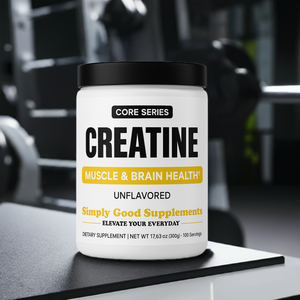
Our Simply Good Supplements Creatine Monohydrate provides 5 grams of pure, unflavored creatine monohydrate per serving. No proprietary blend. No unnecessary extras. Just creatine.
For someone who wanted to replicate the 10 gram daily dose used in this particular study, that would equal two 5 gram servings per day.
That doesn't mean everyone needs 10 grams. It simply makes the math pretty easy.
Creatine Doesn't Replace Resistance Training
I want to come back to this because the nonexercise findings make it easy to walk away with the wrong message.
Yes, the creatine group that didn't participate in structured exercise gained lean tissue and improved strength.
That's interesting.
But exercise produced broader changes in body composition and physical performance, and creatine generally enhanced those adaptations when the two were combined.
That's how I think about creatine for healthy aging.
Creatine isn't the foundation.
Resistance training is.
Adequate protein matters.
Staying physically active matters.
Maintaining cardiovascular fitness matters.
Then creatine is a relatively inexpensive, well studied tool that may help you get a little more out of those behaviors while potentially providing benefits of its own.
That's a much more compelling argument than treating creatine like a muscle building shortcut.
The Bottom Line
This new 2026 study adds to what I think is becoming one of the more interesting stories in sports nutrition.
Creatine may actually become more relevant as we get older.
Researchers gave middle aged and older adults 10 grams of creatine monohydrate per day for 12 weeks, either with or without a structured exercise and diet intervention. creatine and middle aged adults
Creatine increased lean tissue and improved strength even without structured training.
When combined with resistance and aerobic exercise plus a calorie restricted diet, creatine helped participants gain lean tissue while producing a greater reduction in body fat percentage.
There were also some promising findings involving memory, cognition, blood lipids, and HbA1c.
I'm considerably less confident about those.
The researchers appropriately describe the individual cognitive and metabolic findings as exploratory, and they need to be replicated before we start treating creatine as a proven nootropic or metabolic health supplement for middle aged adults.
But we don't need those results to make creatine interesting.
Maintaining muscle, strength, and physical capacity as we age is already a good enough reason to pay attention.
Creatine isn't just for the 22 year old trying to add five pounds to his bench press.
At 50, 60, and beyond, maintaining muscle may matter considerably more than adding it did when you were 22.
And that's probably where creatine's future gets a lot more interesting.
Reference
Chun J, Liu Y, Kibler GL, et al. Effects of creatine supplementation with and without exercise and diet intervention on body composition, cognitive function, and markers of health in middle-aged and older adults. Journal of the International Society of Sports Nutrition. 2026;23(S1):2716273. doi:10.1080/15502783.2026.2716273.